A cold snap, a broken heater, or a power cut can leave your cat shivering. The good news is that cats are good at staying warm, and a few simple things help. This guide uses advice from Cats Protection, PetMD, Cornell, the Cat Fanciers’ Association, and two kitten rescue groups. We found no source that covers power cuts directly, so we focus on what the sources do say about keeping cats warm safely.
Is it too cold for your cat?
Cats Protection says a cat’s normal body temperature is 38 to 39°C (100 to 102°F). It says there is no need to put the heating on for a healthy cat unless the indoor temperature drops to 7°C (45°F) or lower. It lists elderly cats, sick cats, kittens, and cats with little or no fur as the cats that feel the cold most.
Outside is different. PetMD says any cat living outdoors where temperatures fall below 32°F (0°C) is at risk, and that high winds on very cold days raise the danger. Try the check below.
Is it too cold for my cat?
Answer three things. This uses guidelines from Cats Protection, PetMD and the National Kitten Coalition. It is a guide, not a diagnosis.
Signs your cat is too cold
Text version of this figure
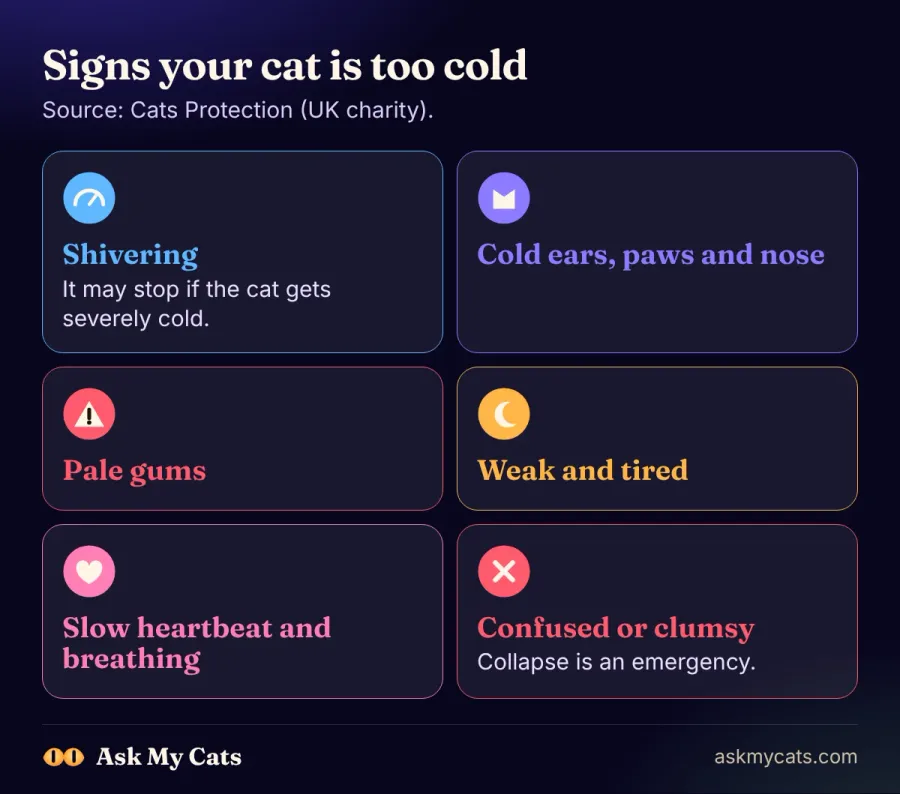
Six signs a cat is too cold: shivering, cold ears paws and nose, pale gums, weak and tired, a slow heartbeat and breathing, and confusion or clumsiness.
Cats Protection notes that if a cat gets severely cold, it may stop shivering, which is not a good sign. Cornell says cats burn more calories to stay warm in winter, so feed a bit more.
If your cat is very cold
Text version of this figure
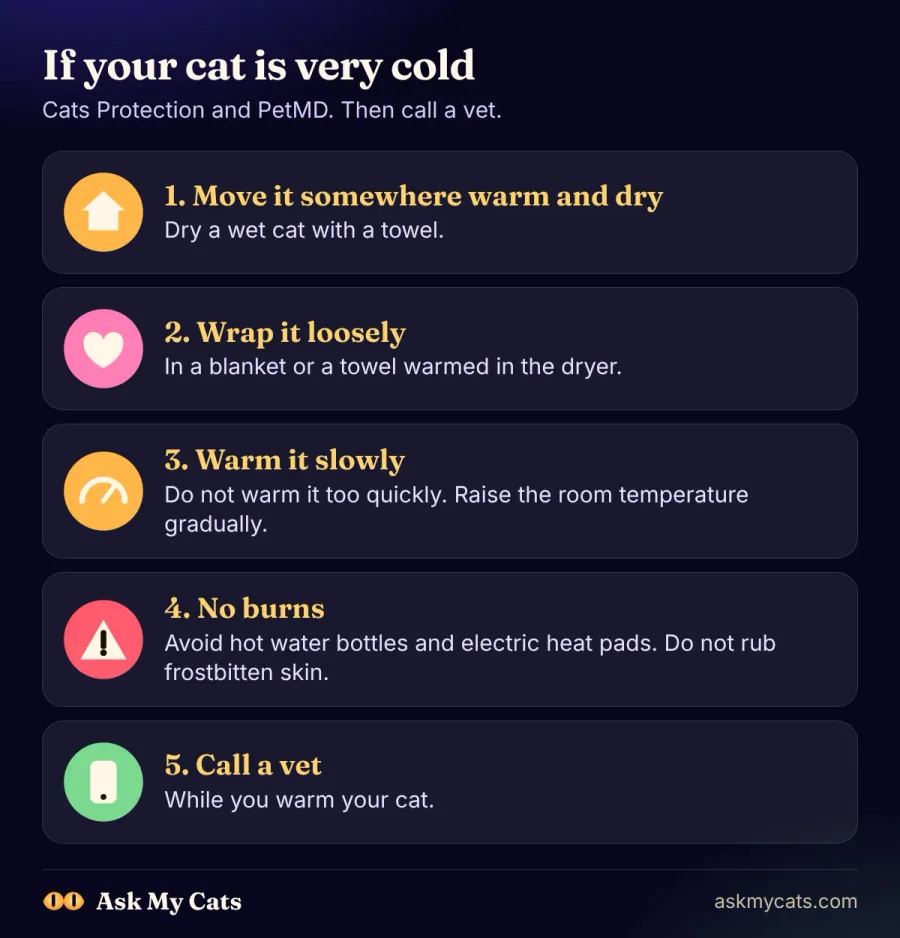
Five steps for a very cold cat: move it somewhere warm and dry, wrap it loosely in a blanket or towel warmed in the dryer, warm it slowly, avoid hot water bottles and electric pads, and call a vet.
Cats Protection says to dry a wet cat with a towel, loosely wrap it in a blanket or towel, offer lukewarm water, and gradually raise the temperature around it while you call the vet. It warns not to warm a cat up too quickly, and not to risk burns with a hot water bottle or electric heat pad. PetMD suggests towels warmed in a dryer, and says not to rub frostbitten skin or use a hair dryer. Re-warm frozen skin with warm, not hot, water, then pat dry.
Safe ways to keep a cat warm without electricity
Text version of this figure
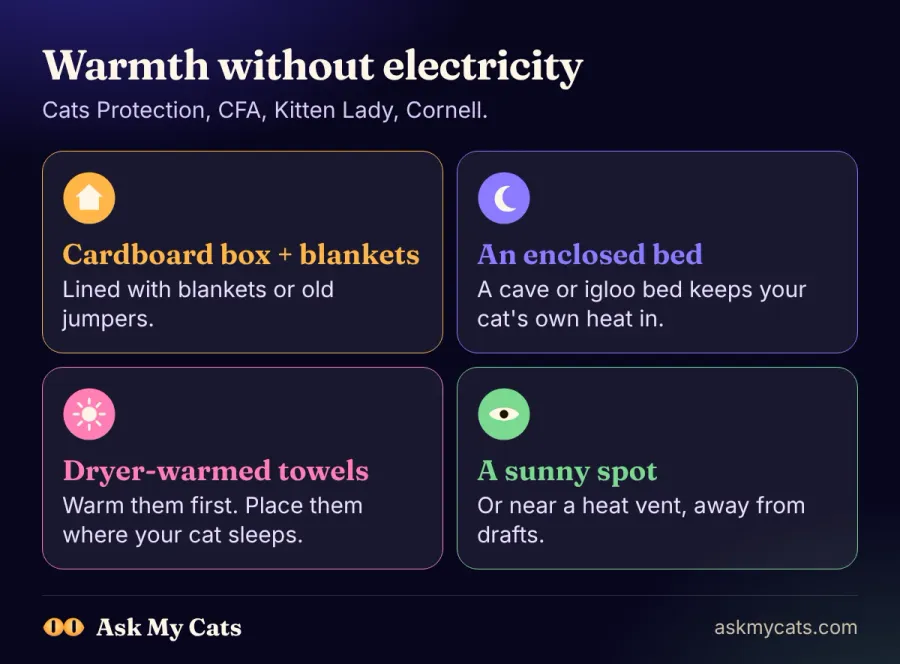
Four ways to keep a cat warm without electricity: a cardboard box lined with blankets, an enclosed cave or igloo bed, dryer-warmed towels, and a sunny spot or a spot near a heat vent.
- A cozy box. Cats Protection says cardboard boxes lined with blankets or old jumpers work perfectly.
- An enclosed bed. The Cat Fanciers’ Association says cave or igloo beds are designed to radiate your cat’s own heat back to it.
- Warm towels. The CFA suggests running a few towels or blankets through the dryer for a cycle. Do this before a power cut, and put them where your cat sleeps.
- The right spot. Cats Protection says to put beds in quiet, warm, dry places away from drafts. The CFA suggests a sunny window or near a heat vent.
- Keep cats in at night. Cats Protection says to keep cats indoors at night, with a litter tray inside.
- Do not use a human heating pad. The CFA says human heating pads are too hot and can burn an animal.
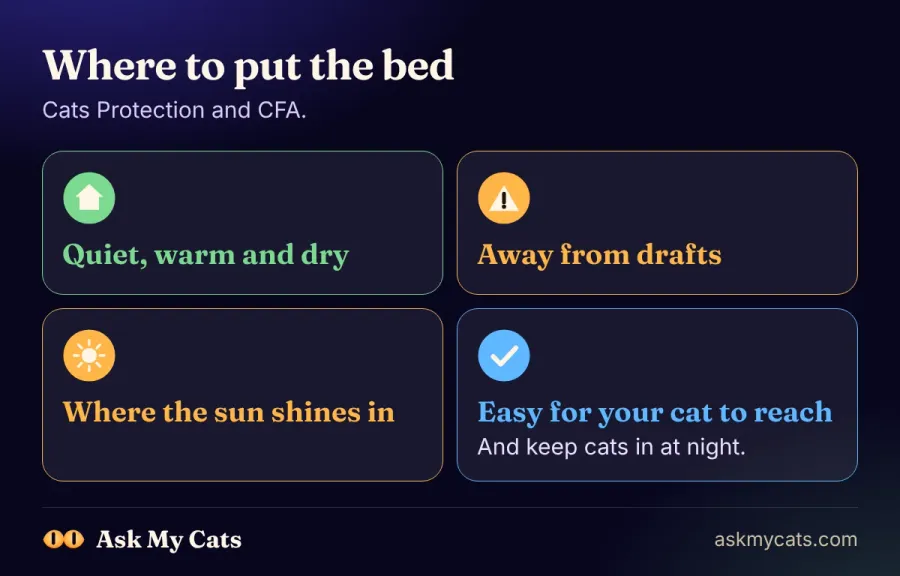
Text version of this figure
Four tips for placing a cat bed: quiet, warm and dry; away from drafts; where the sun shines in; and easy for your cat to reach.
Warm cat checklist
Tap each one you have done.
Very young kittens need more
Kittens cannot warm themselves. The National Kitten Coalition says they do not develop a shivering reflex until about 2 weeks and cannot regulate their body temperature until about 4 weeks. Their mother keeps them warm. If a kitten is on its own, warm it first and call a vet or rescue. See our guide on what to feed a newborn kitten.
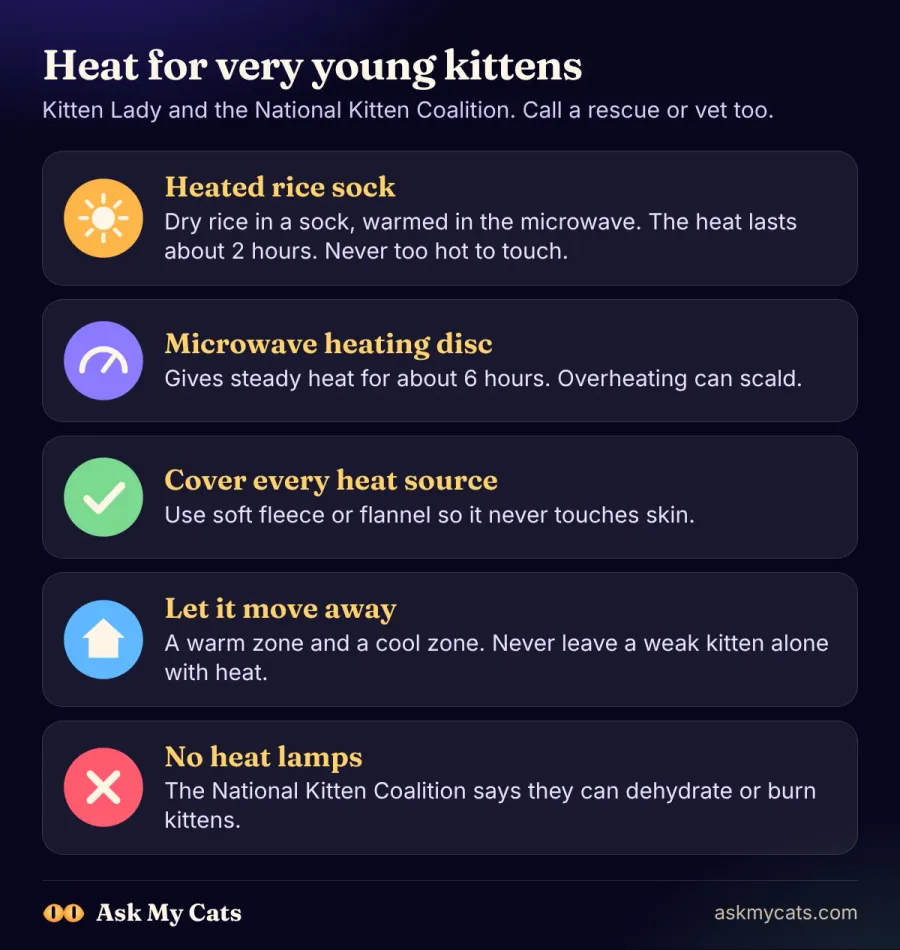
Text version of this figure
Five tips for warming very young kittens: a heated rice sock lasts about 2 hours, a microwave heating disc lasts about 6 hours, cover every heat source with fleece, let the kitten move away to a cool zone, and never use a heat lamp.
Kitten Lady and the National Kitten Coalition describe these non-electric options:
- Heated rice sock. Dry rice in a clean sock, warmed in the microwave. Kitten Lady says the heat wears off after about 2 hours, and not to use one too hot for you to touch.
- Microwave heating disc. Kitten Lady says it gives steady heat for about 6 hours, but overheating can scald a kitten.
- Cover everything. The National Kitten Coalition says all heat sources should be covered so they never touch skin. Use flannel or fleece, which will not catch tiny claws.
- Let the kitten move away. Kitten Lady says to give a warm zone and a cool zone. Never leave a weak kitten alone with a heat source.
- No heat lamps. The National Kitten Coalition says a heat lamp is not safe because it can dehydrate or burn kittens.
Never feed a cold kitten, and warm it slowly over 1 to 3 hours, says the National Kitten Coalition.
Outdoor cats and frostbite
Cornell says to keep cats indoors at all times if you can. If a cat lives outside, give a raised shelter with straw (not newspaper, cloth or hay). Our guide on feeding feral cats in winter shows how to build one.
PetMD says frostbite usually hits the ears, tail, paws and nose. It may not show for days or weeks.
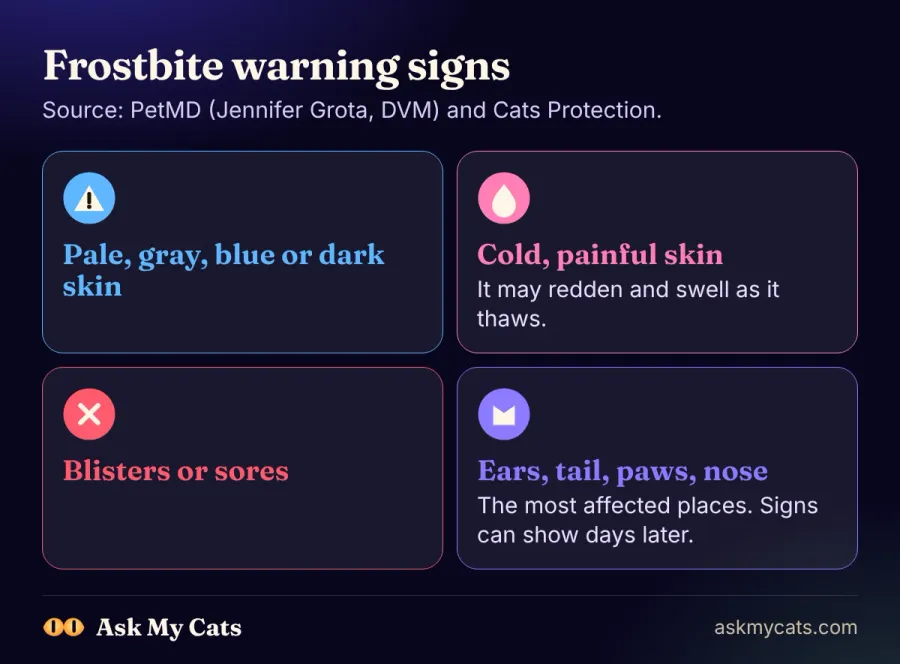
Text version of this figure
Four frostbite warning signs: pale, gray, blue or dark skin; cold painful skin that reddens and swells as it thaws; blisters or sores; and the ears, tail, paws and nose are most affected.
Also check under the hood and around the wheels of your car before you drive, says Cornell, and keep antifreeze out of reach.
Related guides
- Do Fake Owls Keep Cats Away?
- Do Mothballs Keep Cats Away? No, and They Can Poison Them
- Do Used Tea Bags Keep Cats Away?
- How Do Stray and Community Cats Survive Winter?
- Why Does a Stray Cat Follow You?
Quick answers
Is a hot water bottle safe?
Cats Protection warns against using a hot water bottle or electric heat pad to warm up a very cold cat, because of burn risk. For kittens, the rescue groups say to cover any heat source and let the kitten move away.
Should I use a heat lamp?
The National Kitten Coalition says a heat lamp is not safe for kittens. We found no source that recommends one for adult cats.
Do cats need a sweater?
We found no source that recommends clothing for healthy cats. Beds, blankets and a warm room work better. Ask your vet about a hairless or very senior cat.