
Finding poop on the couch or the bed is upsetting. It is not revenge. Cornell says cats probably do not have the kind of thinking needed to take revenge. This guide covers what vet sources say, in plain words. It is general information, not veterinary advice. If your cat poops under the bed instead, see why a cat poops under the bed.
The main reasons
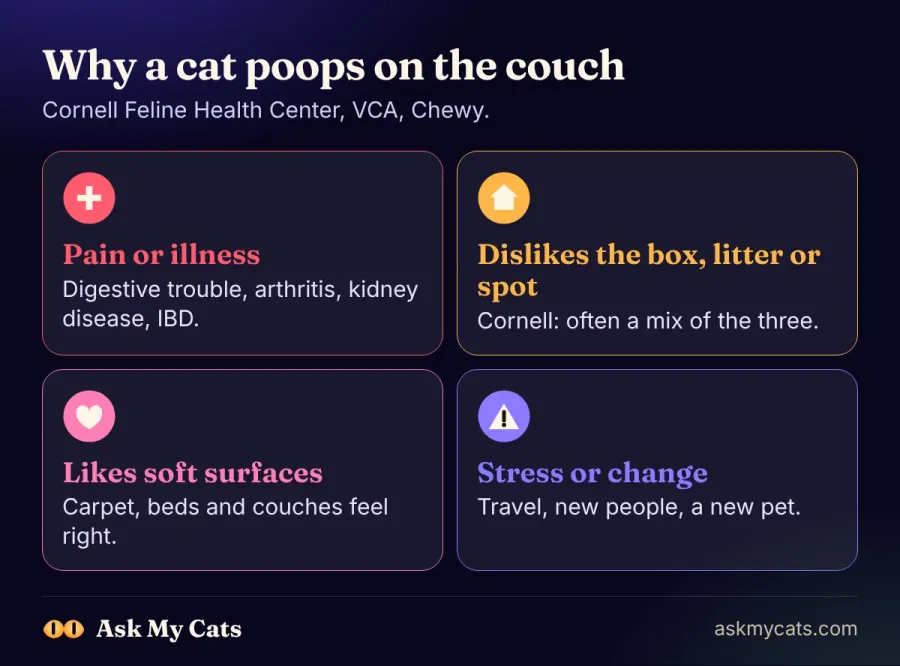
Text version of this figure
Four reasons a cat poops on the couch: pain or illness such as digestive trouble, arthritis, kidney disease or IBD; dislike of the box, litter or spot; liking soft surfaces; and stress or change such as travel, new people or a new pet.
Health. Cornell says digestive problems can make pooping painful, more frequent, or harder to control, and that age can bring joint pain or confusion. VCA says a cat in pain may look for a place where it can stretch, and may link the box with the pain. It lists gut inflammation (IBD), bone and joint pain and nerve pain. It says kidney disease and diabetes can raise how much stool a cat makes, so the box gets dirty faster.
The box, the litter, or the spot. Cornell says a cat may dislike the box, the litter, the location, or all three. Cats with this problem will usually go on a variety of surfaces, including carpets, beds or clothing.
Soft surfaces. Cornell says cats that prefer certain surfaces usually stick with that choice. A couch or bed is soft, and may feel right.
Stress. Chewy tells of a cat that pooped on a bed after its owner’s business trip. VCA (in a part of the page we only saw as a summary) says stress or conflict with another cat or person can drive marking.
Aversion or marking?
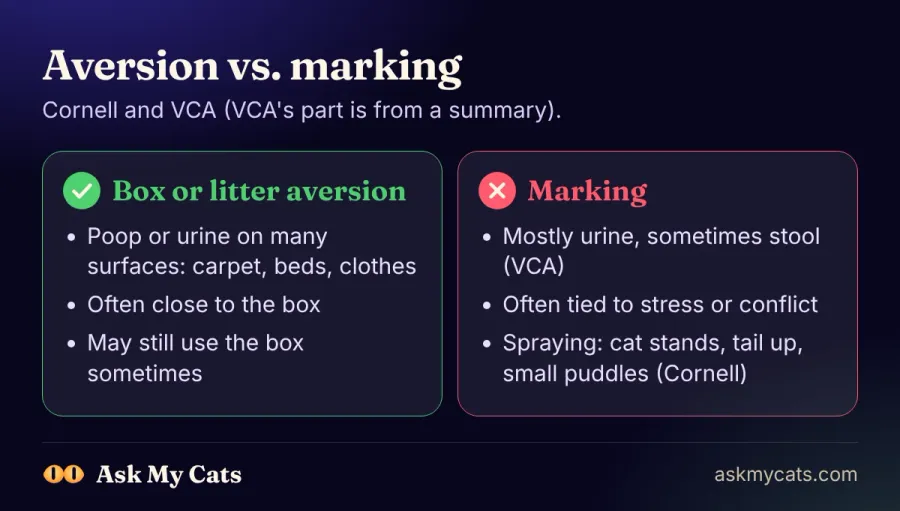
Text version of this figure
Two lists. Box or litter aversion: poop or urine on many surfaces such as carpet, beds and clothes, often close to the box, and the cat may still use the box sometimes. Marking: mostly urine and sometimes stool, often tied to stress or conflict, and spraying looks like a standing cat with tail up leaving small puddles.
Cornell says spraying is urine: the cat stands, lifts its tail and quivers, and leaves small puddles on upright surfaces. It does not squat. VCA’s page (as summarized) says marking is mostly urine and sometimes stool, and that aversion deposits are very close to the box. None of the pages we read gave a clear test for poop alone, so a vet or behaviorist can help if you are not sure.
What does my cat do?
Do not do this
See the vet first.
Cornell says to take the cat for a full exam and tests, and that cats with health problems do not always act sick. VCA says lab work and a fecal test are part of it.
Unproven
Try a softer, finer litter.
Cornell says to buy a softer, finer litter and put a carpet scrap in the box if your cat likes soft surfaces. Also check box size and cleanliness.
Unproven
Box aversion is likely.
VCA says aversion deposits are often very close to the box. Check the litter, size, cleanliness and location, and test one change at a time.
Unproven
Stress may be a factor.
Chewy gives an example after a trip. Keep routines steady, add boxes, and see your vet to rule out illness.
Unproven
Find out which cat, and add boxes.
Cornell says to have as many boxes as cats, plus one. It suggests a way to find the culprit using non-toxic crayon bits in food. Ask your vet about that, or confine one cat at a time.
Step 1: the vet
Cornell says: “Once you have identified the house-soiling cat, it is wise to take him to your veterinarian.” VCA says a physical exam and lab work, including a urine test and a fecal exam, are the start. If nothing physical is found, VCA says to see a veterinary behaviorist.
Step 2: fix the box
Cornell says most cats prefer unscented, finer-textured litter about 1 to 2 inches deep, and an uncovered box, since covers hold odors in. It says to have as many boxes as cats, plus one. Big cats need bigger boxes, and kittens and older or arthritic cats need low sides. VCA (as summarized) says a box about 1.5 times your cat’s length is usual. Scoop daily.
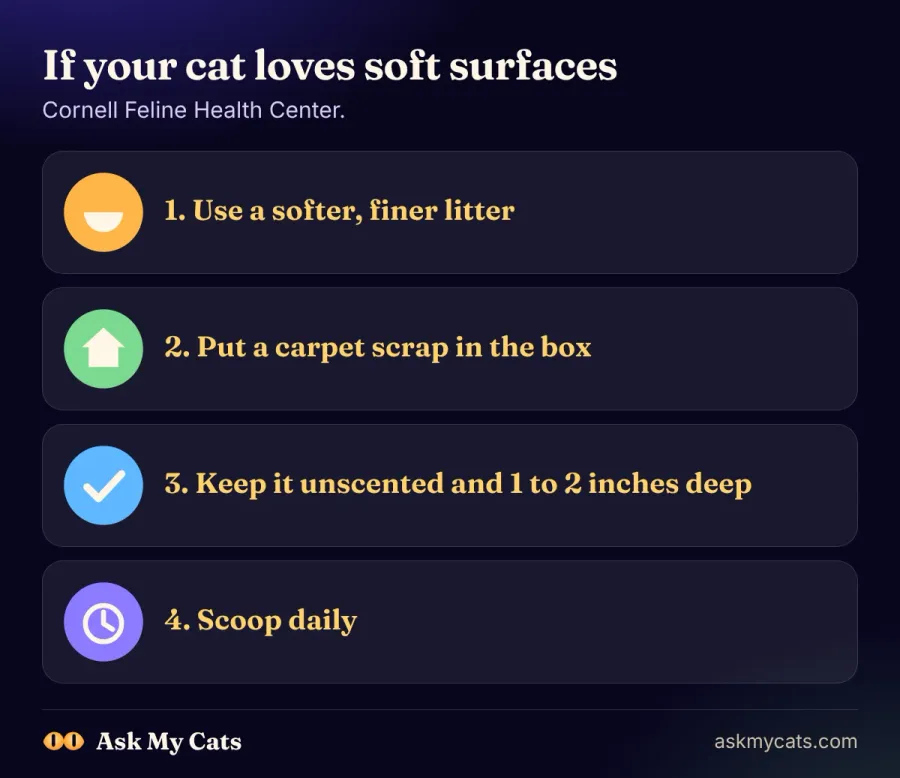
Text version of this figure
Four steps if your cat loves soft surfaces: use a softer and finer litter, put a carpet scrap in the box, keep litter unscented and 1 to 2 inches deep, and scoop daily.
Cornell’s tip for cats that like soft surfaces is to use a softer, finer litter and put a carpet remnant in the box. If you want to move a box, Cornell says to put it in the cat’s chosen spot first, then move it a few inches a day. If your cat stops using it, go back to the last place that worked.
VCA (as summarized) suggests a litter test: two boxes, one change at a time, for one to two weeks each, with a notebook.
Step 3: clean and block the couch
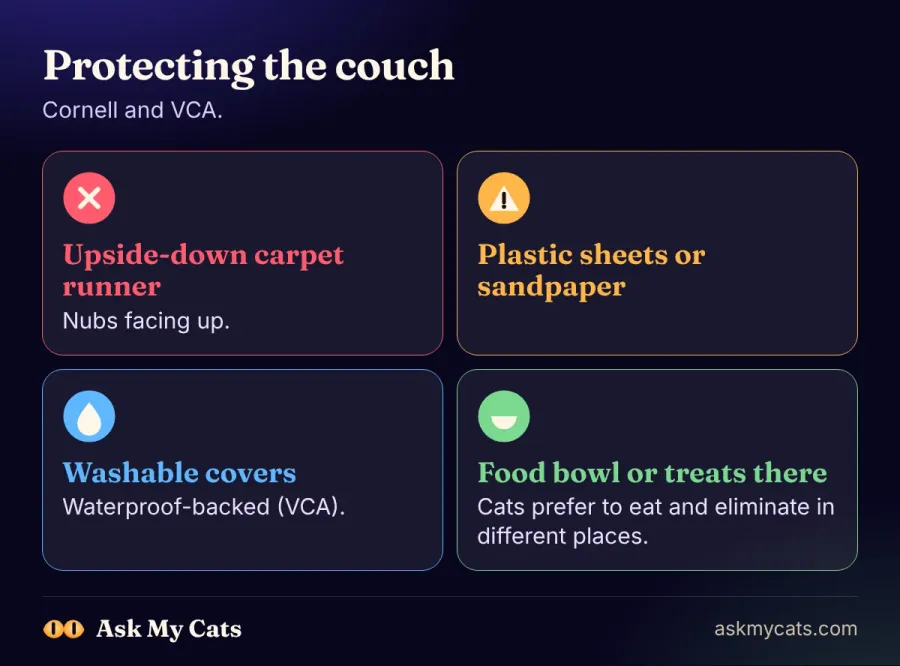
Text version of this figure
Four ways to protect the couch: an upside-down carpet runner with the nubs facing up, plastic sheets or sandpaper, washable covers with waterproof backing, and a food bowl or treats in the soiled spot because cats prefer to eat and eliminate in different places.
Cornell says odors must be “neutralized, not just deodorized,” and to avoid ammonia and vinegar. VCA (as summarized) says to use an enzyme cleaner. To block the spot, Cornell lists plastic sheets, newspaper, sandpaper, or a carpet runner with the nubs facing up, and says baby gates will not keep a cat out of a room. VCA (as summarized) suggests waterproof mattress covers for beds. Cornell adds that you can put food bowls and treats in the soiled spot, because cats prefer to eat and eliminate in separate places.
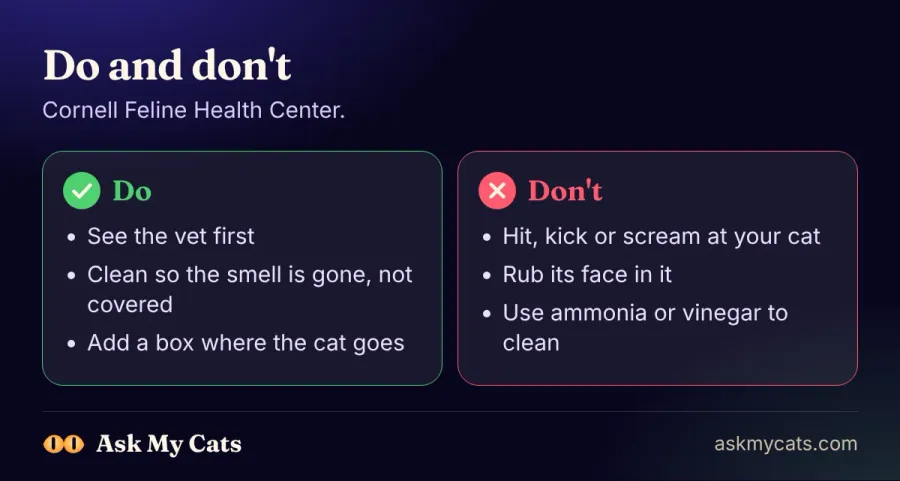
Text version of this figure
Do: see the vet first, clean so the smell is gone and not covered, and add a box where the cat goes. Don't: hit, kick or scream at your cat, rub its face in it, or use ammonia or vinegar to clean.
Cornell says never hit, kick or scream at a cat, and that rubbing a cat’s face in feces is ineffective because the cat cannot link it to what it did. It says punishment may worsen the problem. Cornell also describes startling a cat at the moment it is about to go, but a veterinary behavior paper we read for our guide on cats pooping under the bed warned that water pistols and rattle cans can make cats afraid of the box. We do not suggest them.
My couch-fix plan
Tap each one you have done.
Related guides
- Cat Peeing or Pooping in the Closet
- Neighbor’s Cat Pooping in Your Yard? What Really Works
- Cat Keeps Peeing in the Same Spot?
- Cat Peeing in Houseplants? Why It Happens and How to Stop It
- Cat Pees but Won’t Poop?
Quick answers
Is my cat doing this to get back at me?
No. Cornell says cats probably do not have the thinking needed for revenge.
Will it stop on its own?
Cornell says the longer the behavior lasts, the more likely it becomes a habit. Act early. We found no source with a typical time to fix it.
Should I put the litter box next to the couch?
Cornell says you can put a box in the spot the cat chooses, then move it a few inches a day to where you want it.