Is a tomcat harder on your couch than a female? We looked for evidence, and the answer is: probably no difference. This is general information.
What the research found
A survey of 2,465 cat owners, published in the journal Animals in 2022, found that no cat characteristic, including sex and neuter status, was significantly linked to unwanted scratching. About 58 percent of owners reported unwanted scratching, and furniture was the most common place for damage. Cisneros and colleagues’ survey (2022) leaves out owners of declawed cats.
A pilot study from the University of Georgia group (Moesta and colleagues) had 66 female and 50 male cats but did not analyze sex or neuter status. A 2016 survey (Wilson and colleagues, 4,331 owners) reportedly found the same for inappropriate scratching, but we only saw a summary of its abstract, so we do not rely on it. An Italian study of 128 cats said sex, neutering, age and environment “may modify” scratching as marking, with no direction given.
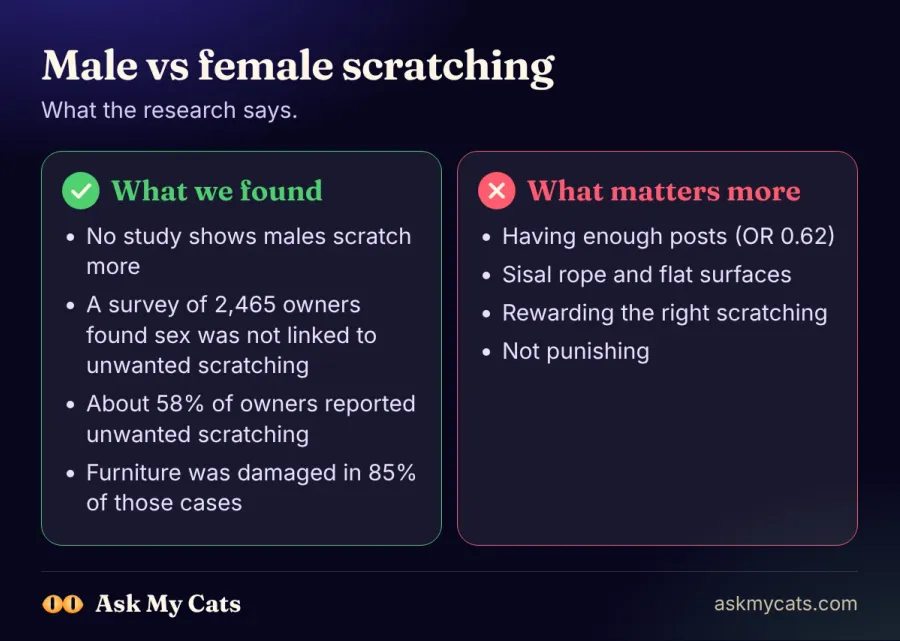
Text version of this figure
Male vs female scratching. What we found: no study shows males scratch more; a survey of 2,465 owners found sex was not linked to unwanted scratching; about 58 percent of owners reported unwanted scratching; furniture was the most common location of damage. What matters more: having enough posts, sisal rope and flat surfaces, rewarding the right scratching, and not punishing.
What does reduce unwanted scratching?
In the same survey, owners who gave extra posts, used sisal rope or flat scratching surfaces, limited access to off-limits areas, used attractants and rewarded use of proper items reported less unwanted scratching. Owners who used fabric scratching material, verbal correction, interrupting the cat or physical correction reported more. The numbers below are odds ratios: below 1 means lower odds of unwanted scratching, above 1 means higher.
- Fabric scratching material3.15
- Verbal correction1.56
- Interrupting scratching1.48
- Physical correction1.29
- Rewarding use of the right items0.78
- Sisal rope0.73
- Extra posts0.62
- Restricting access to off-limits areas0.60
Odds ratios (OR). A number below 1 went with fewer problems, above 1 with more. This is an owner survey, so it shows links, not proof of cause. Source: Owner survey of 2,465 cat owners, Animals, 2022.
Why cats scratch
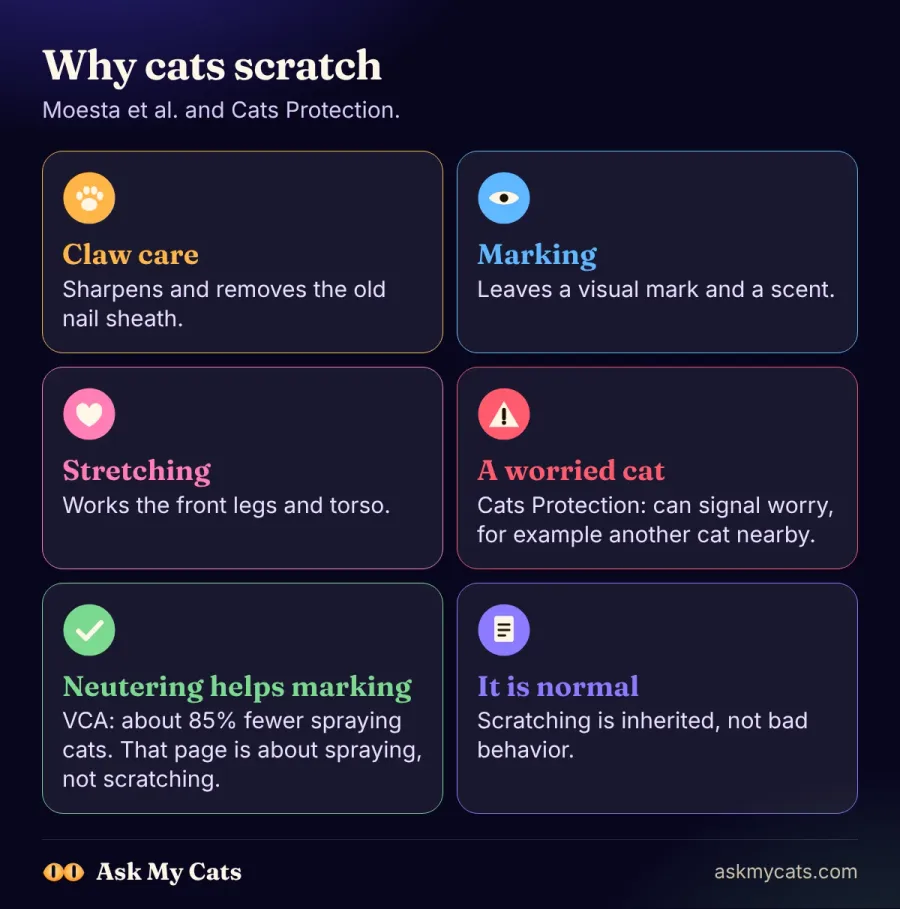
Text version of this figure
Why cats scratch: claw care, which sharpens and removes the old nail sheath; marking by sight and scent; stretching the front legs and torso; a worried cat, per Cats Protection; neutering helps with spraying per VCA, which is not scratching; and it is a normal inherited behavior.
Moesta and colleagues say scratching is normal and inherited, and it sharpens claws, marks visually and by scent, and stretches the front legs and torso. Cats Protection says it can also signal a worried cat, for example one that has another cat nearby, in which case add posts and also address the cause. VCA says neutering cuts spraying in about 85 percent of male cats, but that page is about spraying, so we do not present it as scratching data.
Build a post your cat will use
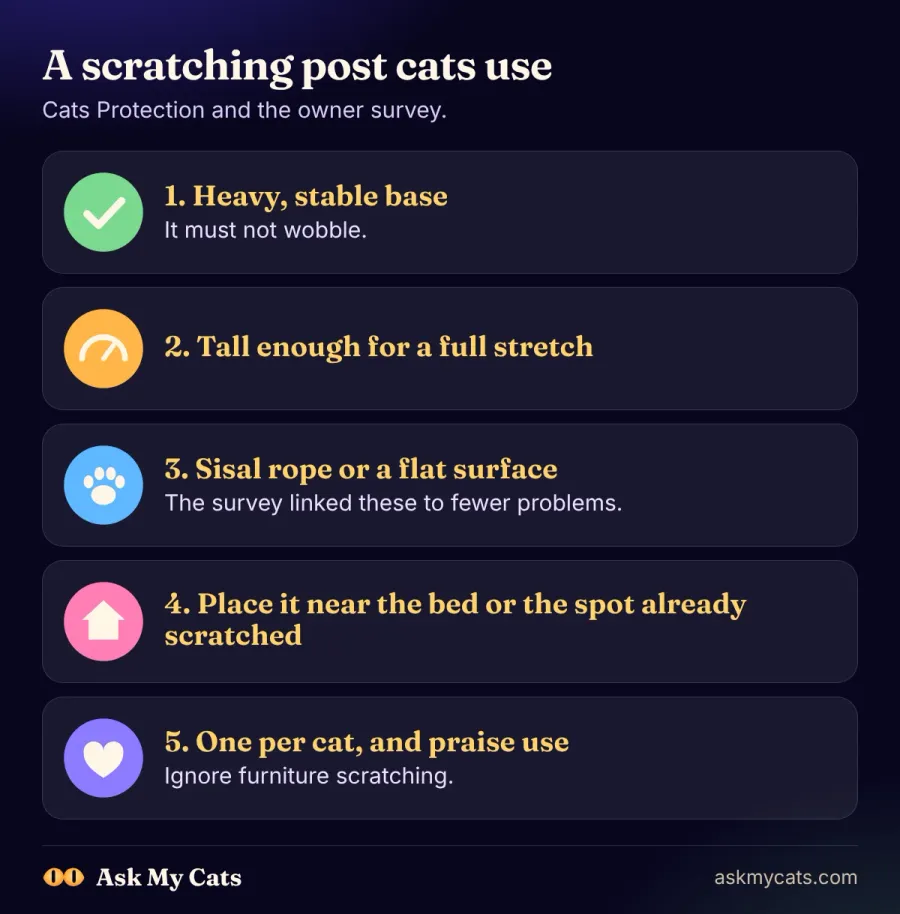
Text version of this figure
A scratching post cats use: a heavy stable base; tall enough for a full stretch; sisal rope or a flat surface; placed near the bed or the spot already scratched; and one per cat, with praise for use and ignoring furniture scratching.
Cats Protection says to pick a heavy, stable post tall enough for a full stretch, place it near the bed or the spot your cat already scratches, give each cat its own, and praise use while ignoring furniture scratching. The Georgia study found no significant effect from the post’s height, material or direction, so the details may matter less than having several in the right places. See also our guides on cat-proofing and claws that do not retract.
Do not declaw
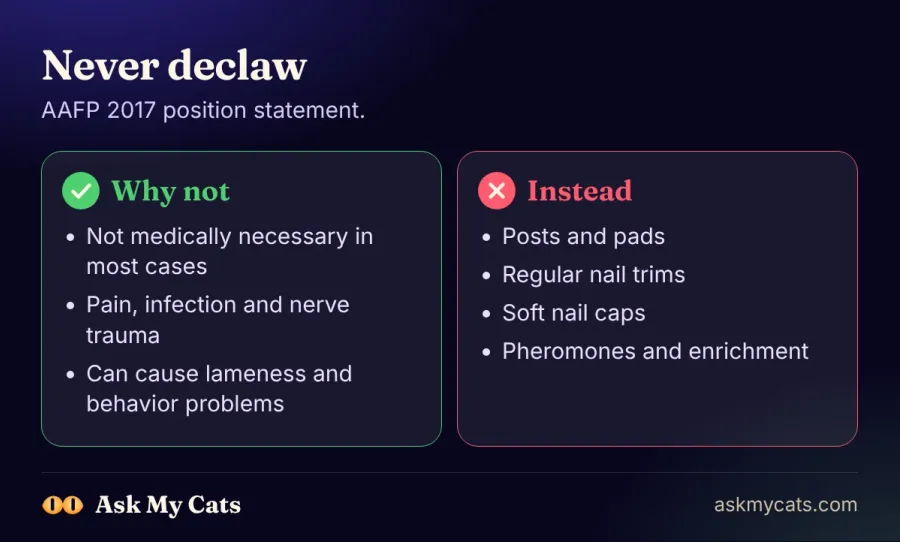
Text version of this figure
Never declaw. Why not: it is not medically necessary in most cases, it risks pain, infection and nerve trauma, and it can cause lameness and behavior problems. Instead: posts and pads, regular nail trims, soft nail caps, and pheromones and enrichment.
The AAFP strongly opposes elective declawing, calling it ethically controversial and not medically necessary for cats in most cases. It names pain, infection, nerve damage, lameness and behavior problems as risks, and suggests posts, nail trimming, soft nail caps, pheromones and enrichment.
Related guides
- Do Black Cats Shed More?
- Do Cats Scratch Leather?
- Do Cats Shed More in the Summer?
- Cat Hair Everywhere? 10 Ways to Cut Down on It
Quick answers
Do neutered cats scratch less?
The survey did not find a link to neuter status. Neutering helps with spraying, which is a different behavior.
What if my cat scratches only one piece of furniture?
Put a post next to it, and praise your cat for using it.
When is scratching a problem?
Cats Protection recommends a behaviorist if you cannot identify the cause of the worry.