You found a baby kitten, or your kitten’s mother is gone, and the store has no kitten formula. Take a breath. This page tells you what vets and rescue groups say to do first. It is general information, not veterinary advice. If you have not read it yet, our guide to what to do with a newborn kitten covers warming and the first steps.
How old is the kitten?
Age changes everything, so start here.
How old is the kitten?
Do not do this
It needs kitten milk replacer. Get it tonight.
Today's Veterinary Nurse says kittens should have only queen's milk or milk replacer in the first 3 to 5 weeks. Warm the kitten, then call a vet, rescue or emergency clinic. Do not wait until morning if you can avoid it.
Unproven
Still needs milk. Weaning may be starting.
VCA and Best Friends say weaning may begin at 3 to 4 weeks, but only some kittens are ready. Milk replacer is still the main food. Call a vet or rescue for formula.
OK, with care
It can learn to eat wet food, but not on its own yet.
PDSA says to introduce wet kitten food at week 4 alongside milk. Alley Cat Allies says to mix formula with wet food so the kitten can lap it up. A kitten this age is still best with formula in the mix.
OK, with care
Wet kitten food and water.
PDSA says weaning is done around 6 to 7 weeks, with wet food and water. Have a vet check the kitten, and ask what to feed.
Unproven
Ask a vet or rescue to judge age.
Age decides the food. A vet or rescue can tell from teeth and size. Until then, treat it as needing formula.
What to do tonight if you have no formula
Text version of this figure
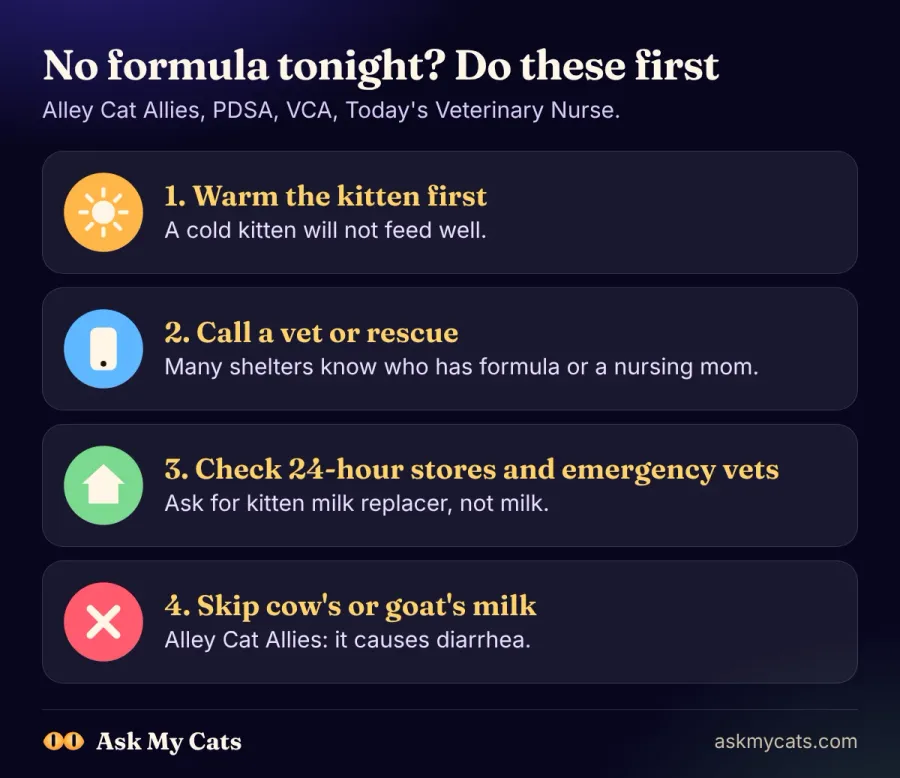
Four steps when there is no formula tonight: warm the kitten first, call a vet or rescue, check 24-hour stores and emergency vets for kitten milk replacer, and skip cow's or goat's milk.
Warm the kitten first. A cold kitten will not eat well. Alley Cat Allies says not to feed chilled kittens, and to warm them first.
Call a vet, a rescue, or an emergency clinic. Alley Cat Allies says to contact vets and no-kill shelters, who may know a nursing mother cat or experienced volunteers who can take the kittens.
Look for kitten milk replacer. Pet stores, vets and some emergency clinics carry it. Ask for kitten milk replacer, not human baby formula. We did not find a vet source that supports human formula.
Why not cow’s milk?
Alley Cat Allies says never to feed kittens cow’s or goat’s milk, because it causes diarrhea. PDSA and VCA also say cow’s and goat’s milk are not suitable, and PDSA says supermarket kitten or puppy milk is not suitable. Today’s Veterinary Nurse says milks from other animals are not appropriate. A baby with diarrhea can lose body water fast, so this is not a small risk.
What about homemade formula?
Experts do not agree. Alley Cat Allies lists one emergency recipe, marked “only use it in emergencies.” PDSA and VCA do not give a homemade option, and Today’s Veterinary Nurse notes that homemade mixes have unknown nutrition and that you should not assume one is enough. So we do not give a recipe here. If the store cannot help, ask your vet or rescue which stopgap they trust, for the few hours until you get formula.
Feeding it right once you have formula
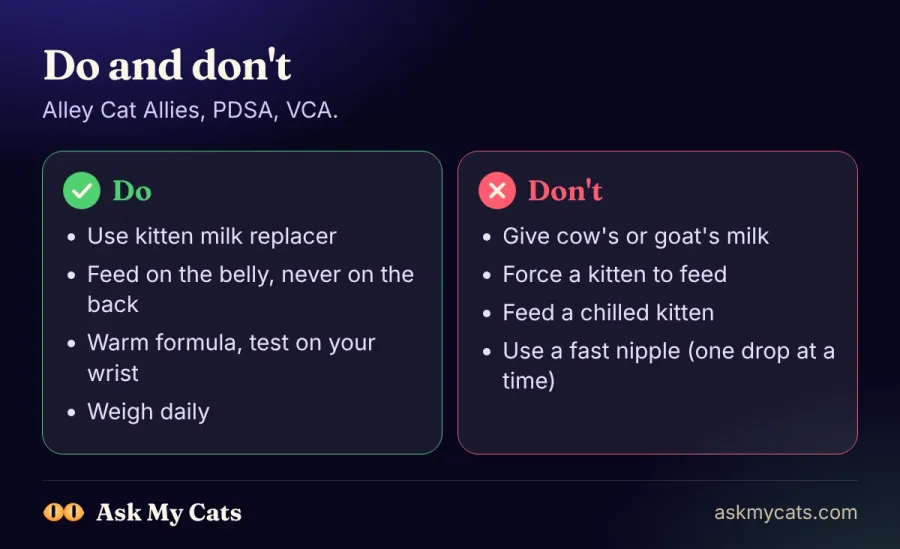
Text version of this figure
Do: use kitten milk replacer, feed on the belly and never on the back, warm formula and test it on your wrist, and weigh daily. Don't: give cow's or goat's milk, force a kitten to feed, feed a chilled kitten, or use a fast nipple; the flow should be one drop at a time.
PDSA, Alley Cat Allies and VCA all say to hold the kitten on its belly, never on its back. VCA says the nipple should let out “one drop at a time,” because fast milk can cause aspiration, pneumonia or death. PDSA says if milk bubbles from the nose, stop, wipe, wait, and try more slowly. Test the warmth on the inside of your wrist.
Sources differ on how often to feed. Here is how they compare:
| Source | First weeks | Later |
|---|---|---|
| PDSA | Every 2 hours in weeks 1 to 3, including overnight | Every 3 hours in week 4 |
| VCA | Every 2 to 4 hours in the first week | Every 4 to 6 hours until weaning |
| Alley Cat Allies | Every 2 hours for ages 10 days and under | 3 to 4 hours (11 days to 2½ weeks), then 5 to 6 hours (2½ to 4 weeks) |
Your vet can tell you what fits your kitten. Under 4 weeks old, kittens also cannot pee and poop on their own. Alley Cat Allies and PDSA say to wipe the bottom gently with a warm, damp cotton ball after each feeding.
Starting wet food (4 weeks and up)
Best Friends says weaning may begin at 3½ to 4 weeks. They say to go in small steps.
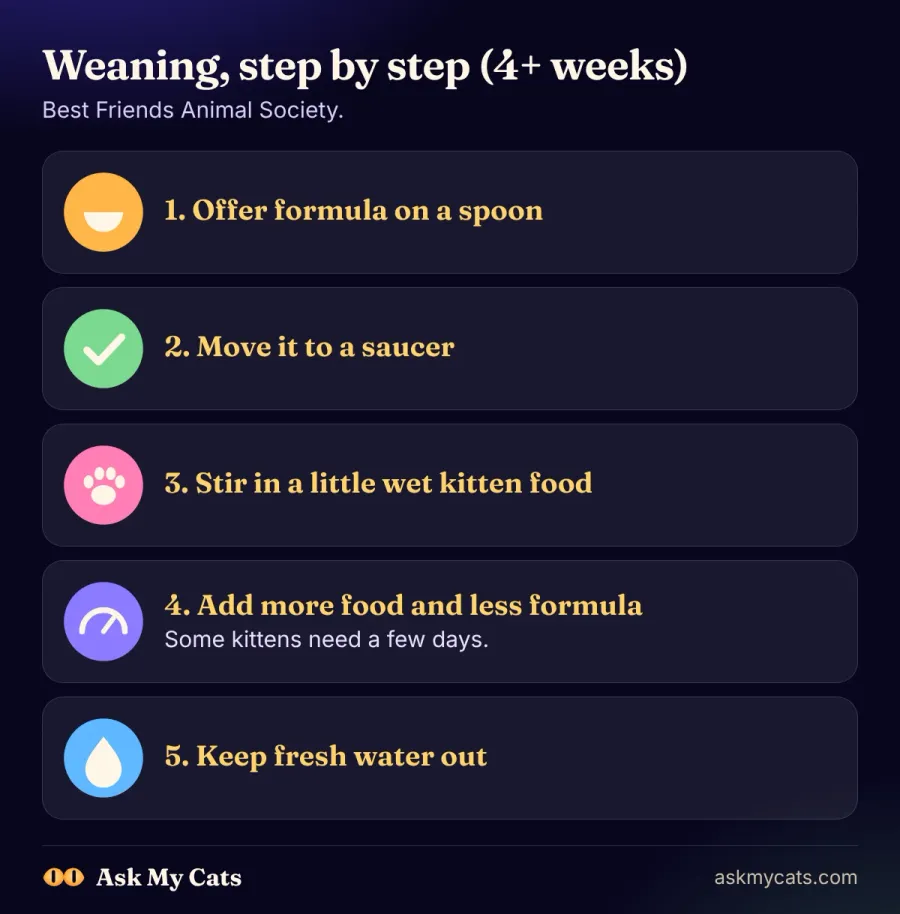
Text version of this figure
Five steps to weaning: offer formula on a spoon, move it to a saucer, stir in a little wet kitten food, add more food and less formula, and keep fresh water out.
Best Friends says some kittens take a few days to get the hang of it. They keep bottle feeding a few times a day until the kitten eats well alone. Once the kitten eats less formula, offer fresh water at all times. We could not read a vet source with an exact food-to-formula ratio, so ask your vet or rescue for one. Today’s Veterinary Nurse says orphaned kittens should not be pushed until they show interest in outside food, since some are not ready at 3 to 4 weeks.
Signs you need a vet
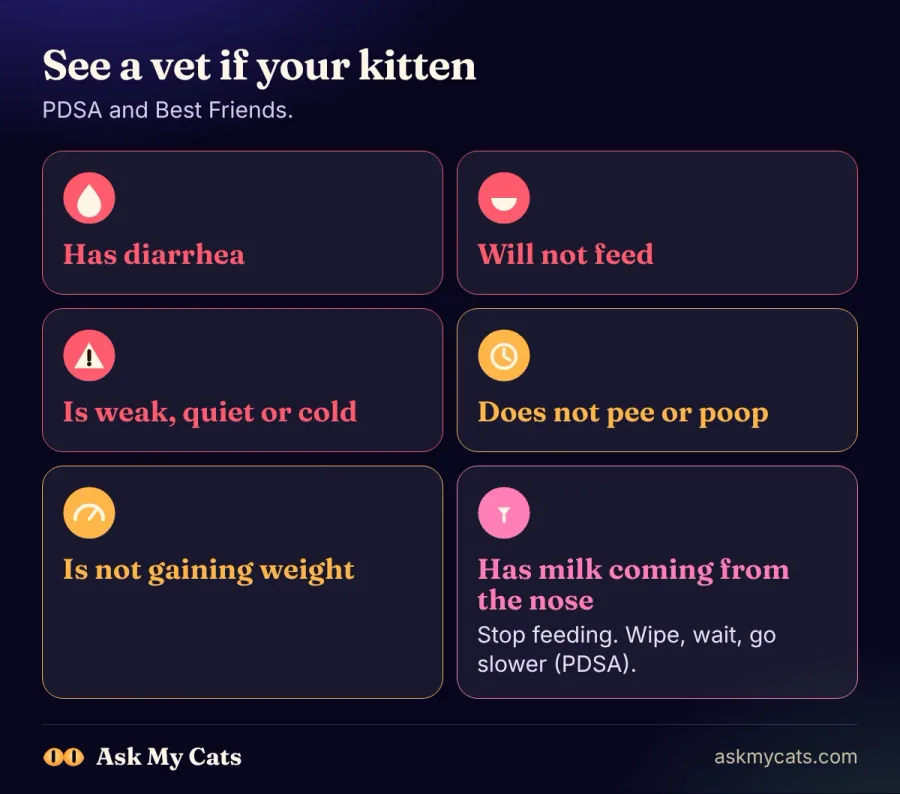
Text version of this figure
Six signs to see a vet: diarrhea, will not feed, weak or quiet or cold, does not pee or poop, not gaining weight, and milk coming from the nose, in which case stop feeding, wipe, wait, and go slower.
Best Friends says kittens should gain about half an ounce a day, or 3 to 4 ounces a week. Weigh the kitten daily, and call a vet if weight is flat or dropping. A scale that shows grams or ounces is best.
Related guides
- What to Feed a Mother Cat After Giving Birth
- Can a Cat Nurse Kittens That Aren’t Hers?
- Can a Non-Pregnant Cat Nurse Kittens?
- Can Cats Sense Labor? What We Know About Cats and Pregnancy
- Cat Teething: When It Happens, Normal Signs
Quick answers
Can I give a newborn kitten regular milk?
No. Alley Cat Allies, PDSA and VCA all say cow’s milk is not suitable and can cause diarrhea.
Can a 3-week-old kitten eat wet food?
Sources say weaning may begin at 3 to 4 weeks, but milk is still the main food. Today’s Veterinary Nurse says not all kittens are ready then. Ask a vet or rescue.
How long can a baby kitten go without eating?
We did not find a safe number. Young kittens need to be fed often, so call a vet right away if a very young kitten cannot get food.
Is there a safe homemade formula?
Experts do not agree, and we did not find a vet-reviewed recipe. Ask your vet.