Some people say their cat goes wild for Vicks or mint balm. Is that real? Here is what is known. This is general information, not veterinary advice.
Do cats like menthol?
The University of Bristol’s chemistry page cites many reports of cats acting euphoric after sniffing Vicks VapoRub, Tiger Balm or Bengay. It also says there seem to have been no scientific tests to prove this. It says menthol is only passably similar to the molecule that excites cats in catnip, and mint plants lack that molecule, so something else would have to be involved. Other pet sites say some cats like these products and others avoid them, but we did not read their evidence, so we cannot rely on it.
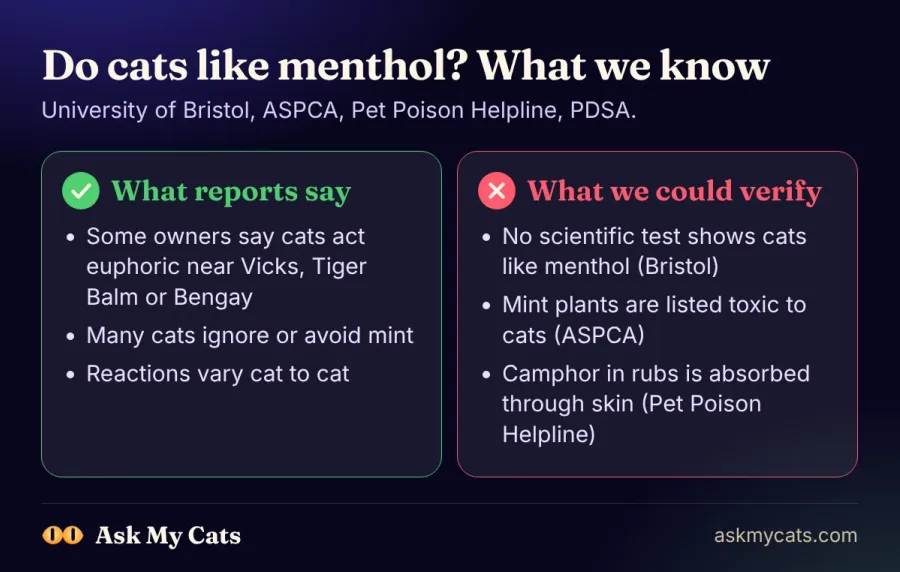
Text version of this figure
Do cats like menthol? Reports say some owners see cats act euphoric near Vicks, Tiger Balm or Bengay, many cats ignore or avoid mint, and reactions vary. What we could verify: no scientific test shows cats like menthol, mint plants are listed toxic to cats by the ASPCA, and camphor in rubs is absorbed through skin per Pet Poison Helpline.
What science does show
The well-known “cat high” has been studied with other plants. In 2017, Bol and colleagues tested 100 cats. Silver vine worked on 79 percent, catnip on 68 percent, Tatarian honeysuckle on 53 percent and valerian root on 47 percent. Menthol was not part of the test.
- Silver vine79%
- Catnip68%
- Tatarian honeysuckle53%
- Valerian root47%
100 domestic cats were tested. This is a plant test, not a menthol test. We did not review the safety of these plants, so check the ASPCA plant list before buying. Source: Bol et al., BMC Veterinary Research, 2017.
A 2021 study in Science Advances found that a molecule in silver vine (nepetalactol) triggers a rubbing response linked to the cat’s natural opioid system, and rubbing spreads it on the fur. The paper says the vomeronasal system (the “Jacobson’s organ” cats use when they curl their lip) does not appear to be involved in that response. That means the old idea that the lip-curl organ causes the high is not supported for silver vine. We read most of this paper, not all.
Why menthol products are risky
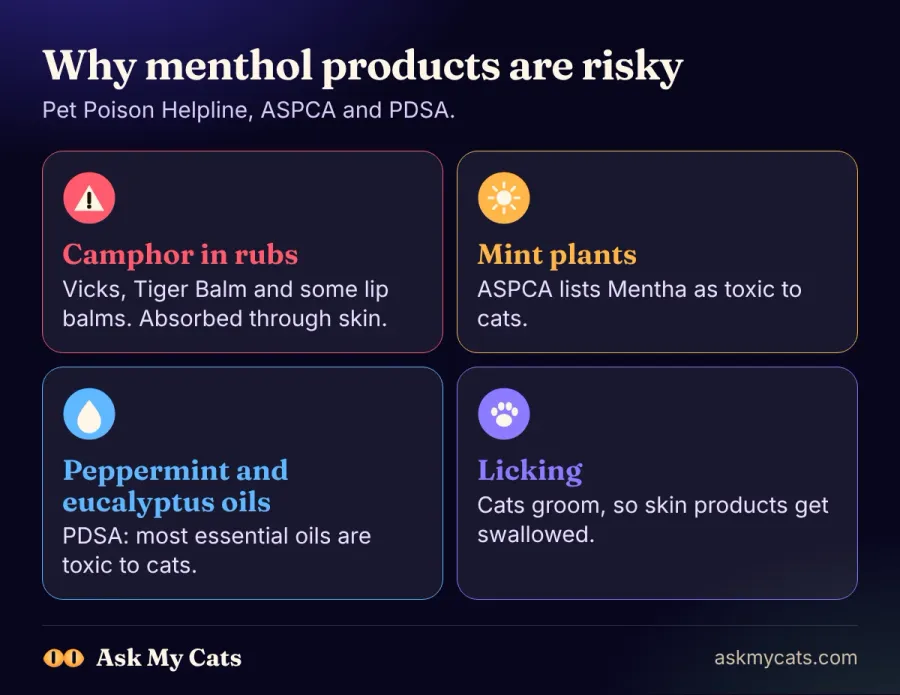
Text version of this figure
Why menthol products are risky: camphor in rubs such as Vicks and Tiger Balm is absorbed through skin; mint plants are listed toxic to cats by the ASPCA; peppermint and eucalyptus oils are toxic per PDSA; and cats lick their skin, so products get swallowed.
Pet Poison Helpline says camphor, found in rubs like Vicks, Tiger Balm and some lip balms, is readily absorbed through the skin. Signs include skin irritation, nausea, vomiting, diarrhea and depression, and large amounts can cause seizures. The ASPCA lists mint (Mentha) as toxic to cats, with vomiting and diarrhea mostly from large amounts. PDSA says the majority of essential oils are toxic to cats, including peppermint and eucalyptus. For more, see our guides on clove oil and cedarwood oil.
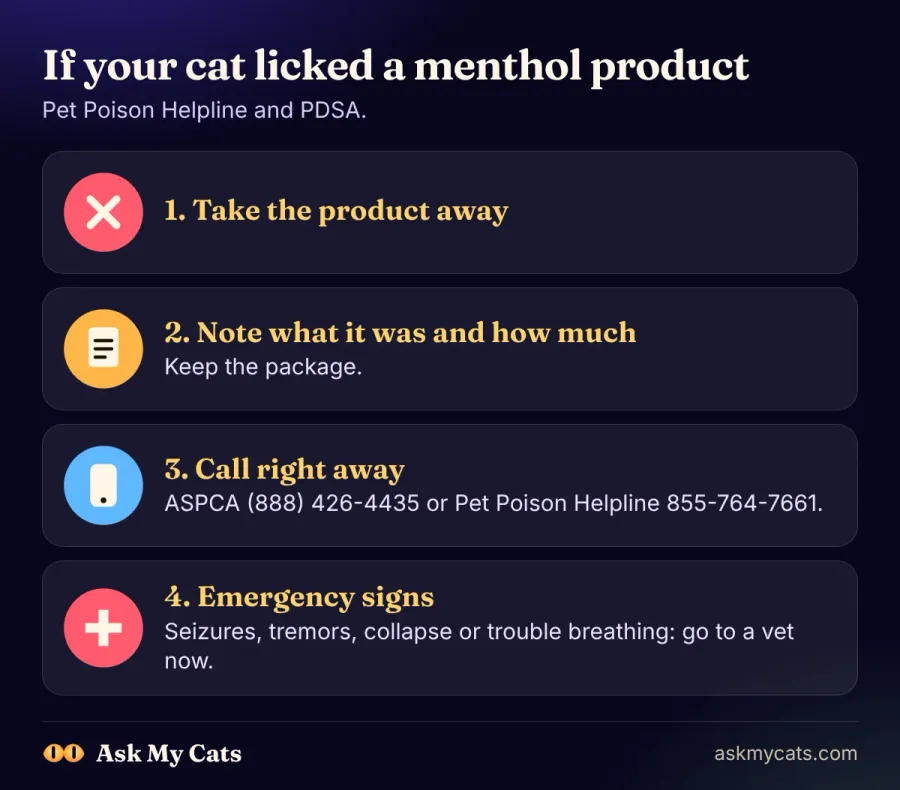
Text version of this figure
If your cat licked a menthol product: take the product away, note what it was and how much and keep the package, call the ASPCA at 888-426-4435 or Pet Poison Helpline at 855-764-7661, and go to a vet at once for seizures, tremors, collapse or trouble breathing.
Related guides
- Is Turmeric Safe for Cats? What Is Known and What Is Not
- Why Do Cats Love Christmas Trees? And How to Keep Them Safe
- Cat Ate a Mouse? What Is Safe, What Is Risky, and What to Do
- Human Food for Cats: What Is Safe, What Is Toxic, and How Much
Quick answers
Why does my cat sniff my Vicks?
We found no study that explains it. It may just be a strong, unusual smell.
Is catnip safer?
Catnip is not listed as a problem in the research we read, but we did not review its safety. For general cat-safe plants, see the ASPCA list.
What if my cat ate mint leaves?
The ASPCA lists mint as toxic to cats, mostly from large amounts. Call your vet or a poison line if you are worried.